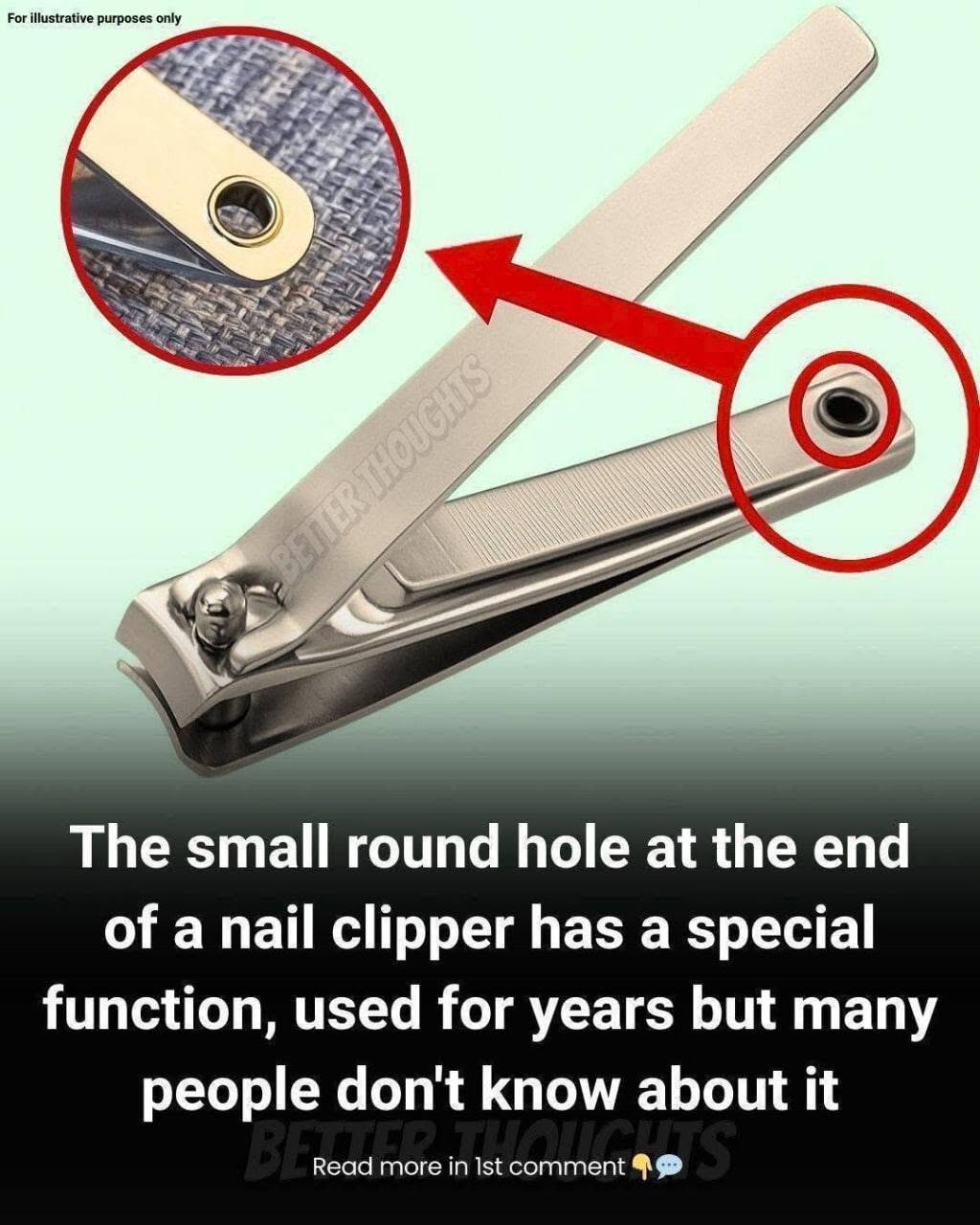
The nail clipper’s pivot mechanism, curved lever, and spring-like tension created by its metal construction are all intended to make cutting more controlled and efficient. Together, these details can reduce the amount of force required and make the tool easier to handle.
A Tool That Thinks About Safety Too
The hole at the end of the handle can also serve practical purposes beyond the cutting mechanism.
Depending on the clipper’s design, a string or key ring can be threaded through the opening, making the tool easier to attach, store, or locate. This can be useful for people who prefer to keep small personal-care tools together or carry them while traveling.
Even the way the lever folds back into the clipper can serve a practical purpose. On many designs, the lever can be rotated into a position that keeps the tool compact when it is not being used, helping reduce the chance of the cutting edges catching on other objects in a bag or drawer.
Once again, seemingly small design choices can anticipate everyday problems such as dropping, misplacing, or accidentally contacting a sharp edge.
But the most interesting part of the nail clipper may be how easily all this engineering disappears once the tool is in your hand.Why We Don’t Notice Good Design
The irony of good design is that it often goes unnoticed.
When something works well, we rarely think about it. We tend to notice design only when it fails — when a lid won’t open, a handle hurts to grip, or a button is difficult to press.
But the best-designed objects can fade into the background. They feel natural, intuitive, and effortless.
The nail clipper is a simple example. Its basic lever-and-pivot arrangement has remained familiar for generations because the underlying mechanical principle is effective. Its components work together to transform a small movement of the thumb into a controlled cutting action.
In many ways, it represents the highest compliment a tool can receive: invisibility.
The next time you reach for a nail clipper, take a closer look at that tiny hole. What appears to be an insignificant opening is actually part of a clever mechanism that demonstrates how thoughtful engineering can turn a simple object into an efficient everyday tool.